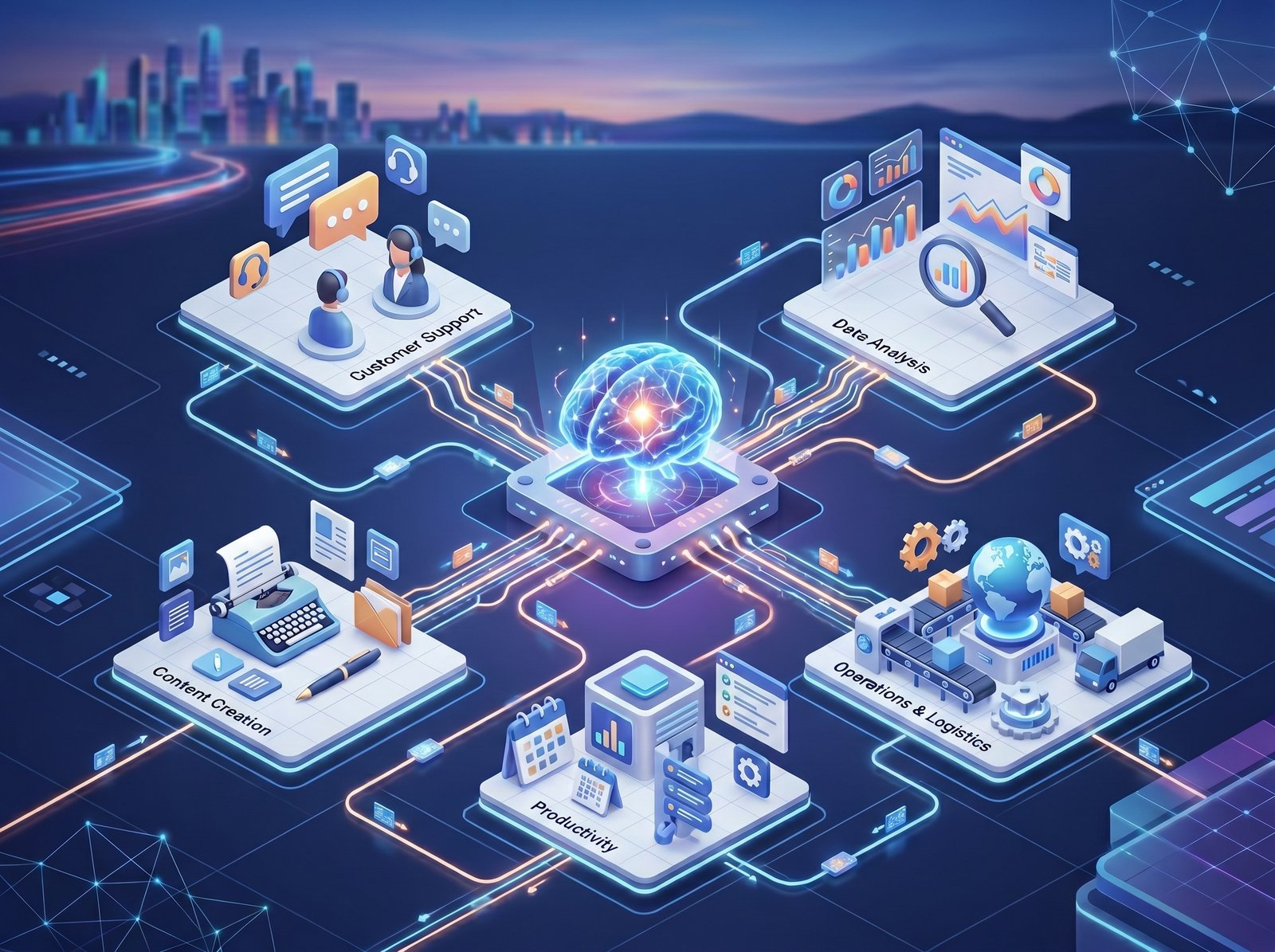
Most businesses that ask us about AI say the same thing: "We want to add ChatGPT to our product." That's the wrong starting point. The right question is: where do we have high-volume, repetitive knowledge work that a language model could handle better than a human? When you start there, the ROI is immediate and measurable. Here are the four integration patterns we've deployed in production in 2024–2025 that consistently deliver genuine business value.
Beyond Chatbots
A chatbot is one LLM integration pattern — and often not the most valuable one. Language models are general-purpose reasoning engines. The highest-ROI integrations are typically invisible to end users: backend automation that processes thousands of documents, generates structured outputs, or makes intelligent decisions that previously required a trained human analyst. The chatbot is the window dressing. The real value is in the plumbing.
Pattern 1: Document Intelligence
The problem: A logistics client was processing 2,000 supplier invoices per day, each requiring a human to read the invoice, extract 12 fields (vendor name, invoice number, line items, totals, tax amounts, payment terms, etc.), and enter them into their ERP system. This was an 8-person team spending 80% of their time on this task.
The solution: We built a document intelligence pipeline using GPT-4o with vision. PDFs are passed through a preprocessing step, then sent to the model with a structured extraction prompt that returns JSON. The output is validated against business rules and written to the ERP via API. Invoices that fail validation are flagged for human review.
The result: 2,000 invoices per day processed in under 4 hours (previously 2 days). Accuracy of 99.2% on clean invoices. The 8-person team was reduced to 2 people reviewing exceptions — those 6 people were redeployed to higher-value work. Monthly cost of the AI system: less than one month's salary of a single invoice processor.
Pattern 2: Automated Report Generation
A financial services client produced weekly management reports — 12-page documents requiring an analyst to pull data from 5 systems, write narrative summaries, identify trends, flag anomalies, and produce recommendations. Each report took 4 hours to produce.
We built an automated pipeline: a data aggregation service pulls from all 5 systems and produces a structured JSON payload. This is passed to Claude Sonnet with a carefully engineered prompt that knows the company's reporting style, key metrics, and how to frame trends and anomalies for a non-technical management audience. The output is rendered into a Word document template.
Report generation time: 4 hours reduced to 4 minutes. The analyst who previously spent 4 hours per report now spends 20 minutes reviewing and adding their own strategic commentary — producing far higher-quality output in less time.
Pattern 3: Intelligent Customer Service Automation
We deployed a Retrieval-Augmented Generation (RAG) customer service system for an e-commerce client receiving 1,200+ support tickets per week. The system retrieves relevant knowledge base articles and order data, then generates accurate, personalised responses.
Crucially, we implemented a confidence scoring system. If the model's confidence falls below a threshold (ambiguous requests, complaints requiring empathy, edge cases not in the knowledge base), the ticket is automatically escalated to a human agent with the AI's draft as a starting point.
Result: 67% of tickets fully resolved by the AI without human involvement. Human agents now handle only complex cases. Customer satisfaction score improved by 18% — faster response times on simple queries, more focused human attention on complex ones.
Pattern 4: Structured Data Extraction from Unstructured Sources
Many businesses have valuable data locked in unstructured formats: email threads, PDF contracts, news articles, CRM notes. LLMs are exceptionally good at extracting structured information from these sources on demand. We use this pattern for competitive intelligence (extracting pricing and feature data from competitor websites), contract analysis (flagging non-standard clauses, extracting key dates and obligations), and lead enrichment (extracting company information from email conversations).
Choosing the Right Model in 2025
- GPT-4o (OpenAI): Best for vision tasks (document processing), complex reasoning, and highest accuracy requirements. Higher cost, but worth it for enterprise accuracy needs.
- Claude Sonnet (Anthropic): Our default for text generation tasks — reports, summaries, content creation. Excellent instruction-following and the best writing quality.
- Claude Haiku / Gemini Flash: For high-volume, low-complexity tasks where cost matters. We use these for classification, routing, and simple extraction at scale.
- Llama / Mistral (self-hosted): For applications with strict data privacy requirements. Slightly lower quality than frontier models but zero data leaves your infrastructure.
Security and Cost Considerations
Never send personally identifiable information (PII) to external APIs without appropriate data processing agreements and privacy controls. Anonymise or redact sensitive fields before LLM processing where possible. Implement prompt injection defences — treat user-provided content as untrusted input and sanitise it before including in prompts.
Cost management is critical at scale. Implement token budgets per request, cache common prompts and responses, use cheaper models for simple classification steps, and monitor token usage with CloudWatch or Datadog alarms. We've seen organisations accidentally spend $10,000/month on LLM API calls due to uncontrolled usage — budget controls from day one prevent this.
Ready to Add Real AI to Your Business?
We help Sri Lankan and global businesses identify, design, and build AI integrations that deliver measurable ROI — not demos.
Discuss Your AI Project →.jpeg)